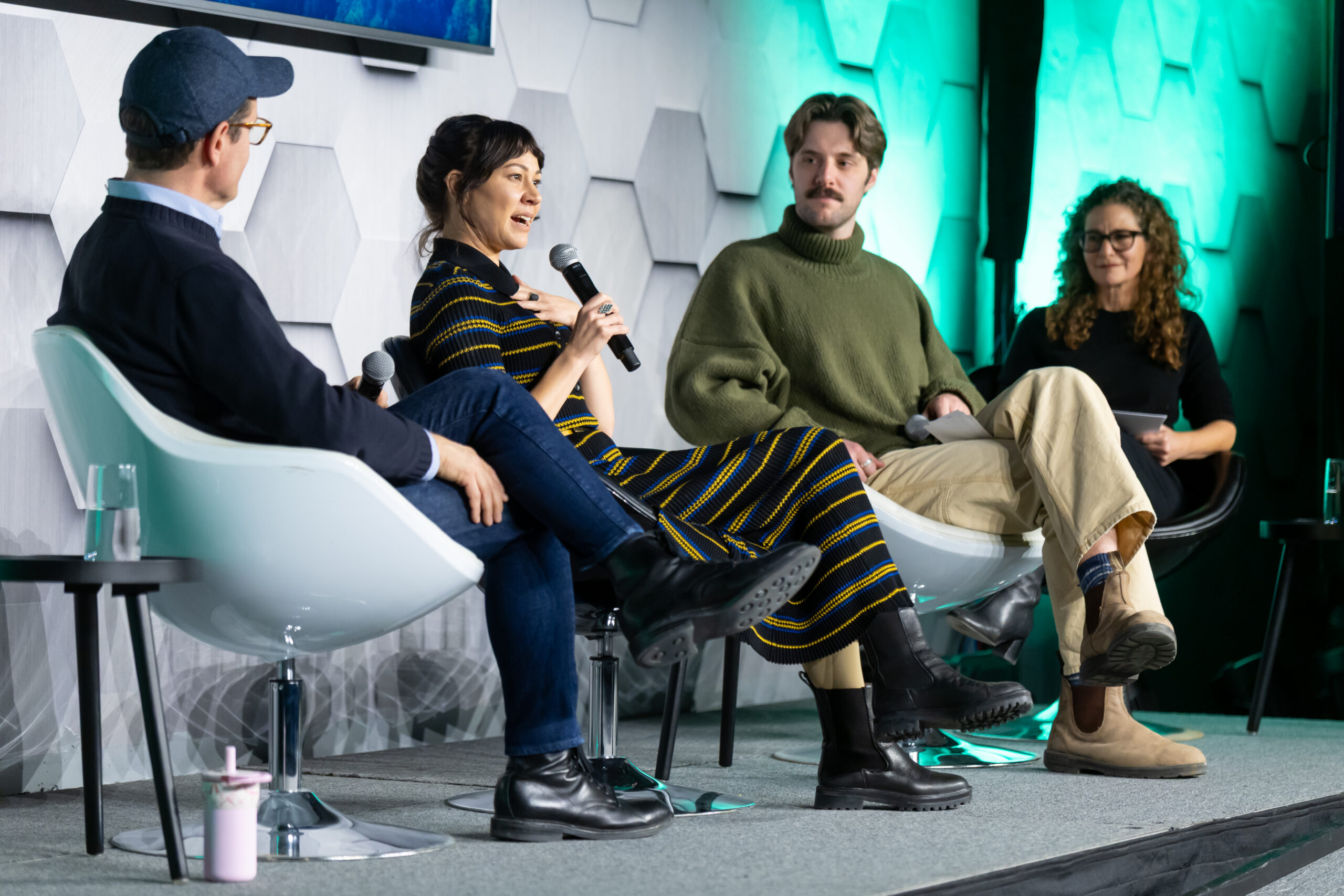
On January 23, 2026, our team had the honor of hosting A Redford Legacy and Exploration: The Future of Environmental Film, a panel at the 2026 Sundance Film Festival. During the event, Panelists reflected on Redford’s belief that film can expand and deepen our relationship to the natural world, elevate underrepresented voices, and strengthen democracy. The conversation examined how environmental stories can make complex issues personal and urgent, and how filmmakers have a unique opportunity to drive solutions and progress as they bridge art, advocacy, and impact in an era of accelerating climate and environmental justice challenges.
The panel was introduced by Amy Redford, who is a Producer and a director. Jill Tidman, The Redford Center’s Executive Director, moderated this conversation between our panelists: Conor Schlosser, The Redford Center Board Chair; Daniel Hinerfeld, Director of Rewrite the Future; and Sara Dosa, Director of Time and Water, Fire of Love, and The Seer & The Unseen).
Standout Quotes from our Panelists
Jill Tidman on finding hopeful stories:
“We’re all storytellers, and I think that we should talk with the people in our lives about these issues. People vastly underestimate the number of Americans who are deeply concerned about climate, and because they underestimate it, they self-censor. So let’s not self-censor. Let’s talk about these issues because we are on the front lines of this story and we can bring people to our side simply by talking. How do you solve a problem that you aren’t able to talk about?
I think that the stories that we tell ourselves really matter… There’s a whole other story out there that is very hard to find. But I would just encourage everyone to go find it. Go find the stories that give you hope because we need that to keep going. And they’re out there.”
Conor Schlosser on Robert Redford’s authenticity:
“Even if [people] didn’t fully always agree with him, I think they respect his authenticity and how he made it so personal. I think he and Jamie together, they knew how powerful film is and how it’s really the most powerful medium to create a sense of empathy and make things feel personal for people. I don’t think you’re ever going to change someone’s mind or create change through shaming them, but if you can create the sense of having a personal stake in something, I think that’s where the most powerful change comes from.”
Sara Dosa on working collaboratively with nature:
“I grew up in a family where curiosity and a kind of a love of nature was very much instilled, and that was something that I got to explore through my own work… I love working with nature collaboratively if that makes sense. I feel like there are so many devastating narratives that we’re bombarded with every day, and have been actually for centuries, that nature is a barren wasteland, is a resource to exploit.
So these stories kind of legitimize intervention in the most exploitative and violent ways… Stories that can instead center on the power, the sentience, the life force of nature can do an act of repair against those violent narratives that cast nature as something to exploit.”
Daniel Hinerfeld on film and empathy:
“Film is magical. It transports us to other places and into other people’s experiences, and it does this amazing thing in that it can substitute or simulate another person’s subjective experience. And that means it’s the basis of empathy, which means it’s an antidote to division and bias and to ignorance and to hate.”
Environmentally focused stories are often personal, under-resourced, and absolutely essential. So, to the filmmakers here in this room, who empty their pockets and often stay in tents and cars, only sleeping on airplanes to make sure to catch that sunrise: This world should be on bended knee in gratitude for your sacrifice.
Thank you. Your environmental stories, your climate stories, your films about environmental justice have never been more critical.
Amy Redford
on gratitude for environmental filmmakers